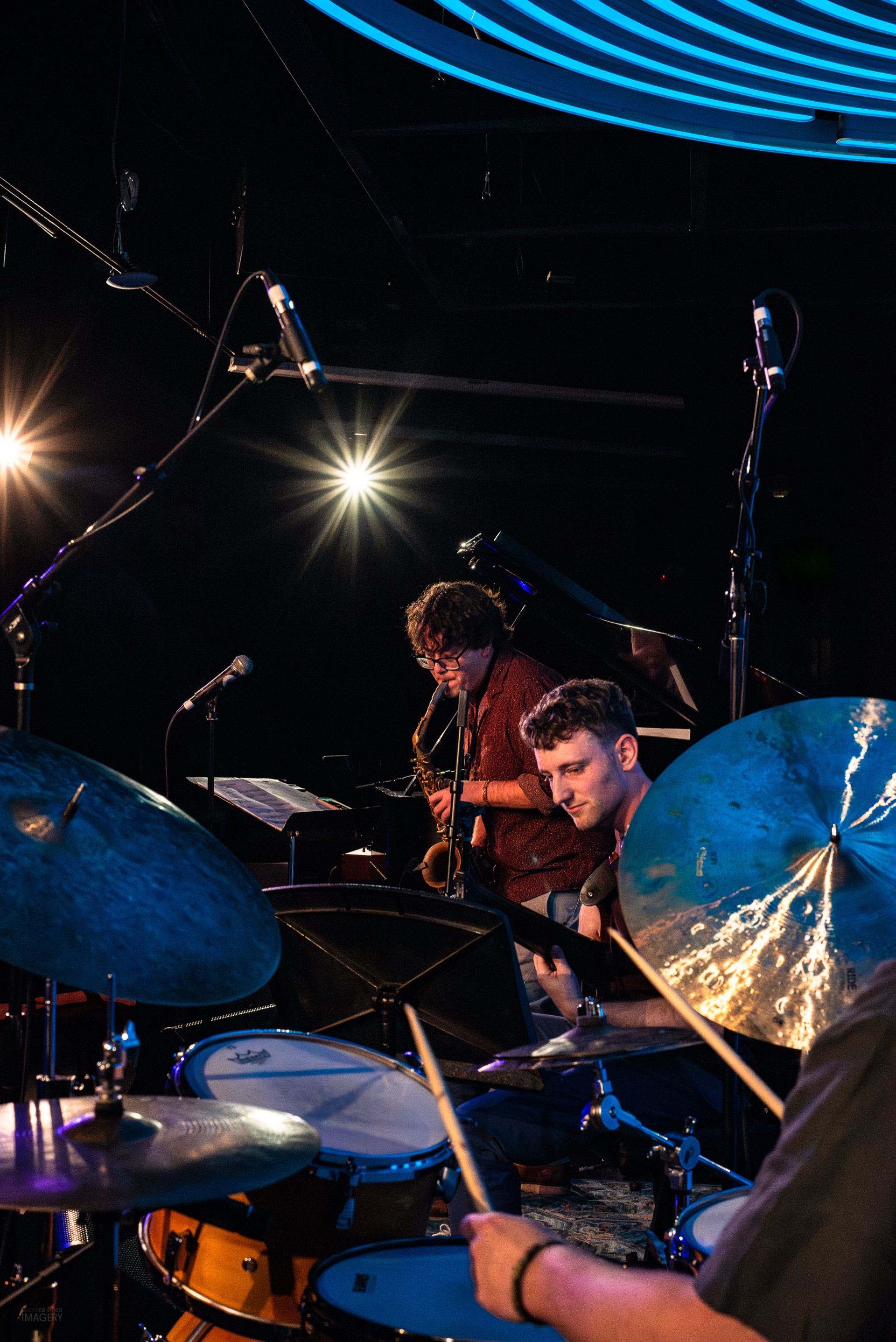
When people find out our band plays the music of Chick Corea and Return to Forever, the most common follow-up is some version of: “I’ve heard of them… where do I start?” Fair question. Return to Forever wasn’t one band so much as three or four bands wearing the same name — gentle Brazilian samba-jazz on one record, roaring jazz-rock on the next — and walking in at the wrong door can leave you confused about why anyone cares.
So here’s the map, from the band that plays this music every week. Eras first, then the albums, then a listening order that won’t steer you wrong.
The short version
Return to Forever (RTF) was the band keyboardist Chick Corea led through the 1970s, and one of the defining groups of jazz fusion — the era when jazz musicians plugged in and played with the volume and ambition of rock. The one constant beside Corea was bassist Stanley Clarke, a virtuoso who changed what the bass gets to do in a band. Around that core, the lineup transformed twice — and each transformation produced essential records.
Era one: light as a feather (1972–73)
The first Return to Forever sounds nothing like what “fusion” came to mean. This band floats. The lineup: Corea on Fender Rhodes electric piano, Clarke on bass, Joe Farrell on flute and saxophones, Brazilian vocalist Flora Purim, and her husband Airto Moreira on drums and percussion.
They made two albums. The self-titled Return to Forever was recorded in February 1972 for ECM, and contains two compositions that became standards: the shimmering ballad “Crystal Silence” and the flamenco-fired closer “La Fiesta.” The follow-up, Light as a Feather — recorded in London that October and released on Polydor in early 1973 — is the masterpiece: “You’re Everything,” “Captain Marvel,” “500 Miles High,” and the most famous thing Corea ever wrote, “Spain.”
This is the era our duo and trio sets draw from most, because the material is melodic, warm, and welcoming — the rare jazz that total newcomers love on first contact. We dissected its centerpiece tune in Spain, Explained, if you want to go deep on one track.
A bonus from the same circle: in March 1972, Corea, Clarke, and Airto backed Stan Getz (with Tony Williams on drums) on Captain Marvel, an album built largely on Corea tunes. It’s effectively a lost RTF record with a tenor legend out front.
Era two: the electric quartet (1973–76)
Then Corea heard the future and rewired the band. Out went the flute and voice; in came electric guitar and a power drummer. Hymn of the Seventh Galaxy (released October 1973) introduced the new shape: Corea, Clarke, guitarist Bill Connors, and drummer Lenny White, playing loud, virtuosic, riff-driven music that met rock on its own turf.
Connors left after that one album, and his replacement defined the classic lineup: a 19-year-old guitar phenomenon named Al Di Meola, who joined in 1974. The quartet of Corea, Clarke, Di Meola, and White made three records that are the spine of the RTF legend:
- Where Have I Known You Before (1974) — the new band finding its voice, alternating solo-piano interludes with full-throttle electric workouts.
- No Mystery (1975) — which won the Grammy for Best Jazz Performance by a Group. The acoustic title track is one of Corea’s loveliest pieces, hiding inside a fusion record.
- Romantic Warrior (1976) — the big one. Their first album for Columbia, their best seller, eventually certified gold. Side-long ambition, knights-and-castles cover art, and ensemble playing of absurd precision. Fusion’s high-water mark for many listeners.
A detail we love as a Colorado band: Romantic Warrior was recorded in February 1976 at Caribou Ranch, the studio outside Nederland — up the canyon from Boulder. The most famous jazz-fusion album ever made is, technically, Colorado music. When we play “Romantic Warrior” material in Denver, it’s a homecoming.
Era three: the big band finale (1977)
One more shape-shift: for 1977’s Musicmagic, Corea and Clarke brought back Joe Farrell, added vocalist-keyboardist Gayle Moran (Corea’s wife), and bolted on a horn section. It’s the band at its most orchestral and most polished — closer to symphonic jazz-pop than to either earlier era. The 1977 tour, captured live at New York’s Palladium, was the final bow. After that, RTF was over as a working band.
The reunions
The story has a coda. The classic quartet — Corea, Clarke, Di Meola, White — reunited in 2008 for a world tour (their first full outing together since a brief 1983 reunion), playing to packed houses and proving the music had only grown in stature. Corea kept revisiting the songbook in new settings until his death in February 2021, at 79, as the most-awarded jazz artist in Grammy history.
Where to start: a listening order
Our honest recommendation, tested on many friends and several skeptical in-laws:
- Start with Light as a Feather. It’s the most immediately lovable jazz-fusion album ever made. If “Spain” and “500 Miles High” don’t get you, this music may not be for you (it will get you).
- Then Romantic Warrior. The other pole — maximum electricity, maximum chops. Listen for how Clarke and White lock together, and how Di Meola’s lines snap against Corea’s synths.
- Then the self-titled Return to Forever for “Crystal Silence” and “La Fiesta” in their first recorded versions — quieter, dreamier, and arguably deeper.
- Then No Mystery and Where Have I Known You Before, in either order, now that you know both poles of the band.
- Finish with Hymn of the Seventh Galaxy and Musicmagic — the hinge album and the grand finale — and the Getz Captain Marvel record as a hidden-track epilogue.
If you’d rather start tune-by-tune instead of album-by-album, we ranked the essential compositions — with the album to find each on — in The Best Chick Corea Songs, Ranked.
Why this music still fills rooms
Fifty years on, Return to Forever material works live for the same reason it worked in 1973: Corea refused to choose between depth and joy. The harmony rewards the jazz heads, the grooves move everyone else, and the melodies are simply better than they had to be. We’ve watched “La Fiesta” bring a gala to its feet and “Crystal Silence” silence a wedding cocktail hour, and we’ve stopped being surprised.
That’s the bet our whole band is built on. Chick Magnet plays this catalog — first era through Elektric Band — as a dedicated tribute show and woven into Latin jazz and standards sets, scaled from duo to quintet.
Hear Return to Forever’s music live
Reading about this band is one thing. Standing in a room while “Spain” hits the trading section is another. If you’re planning a wedding, private event, or booking a venue anywhere in Colorado, tell us about it and we’ll send a custom quote within 24 hours. To catch a public Chick Magnet show first, upcoming dates are at jordanlovinger.com/live.